
AI PUBLISHING SYSTEMS FOR WORDPRESS
AI-Powered WordPress Publishing Systems for News & Content Businesses
Publishing automation should be more than a prompt box. SleekAlgo builds custom WordPress systems that can monitor approved sources or data, process relevant items, create website-specific content, generate SEO fields, apply editorial rules and publish through a controlled workflow.
Source Monitoring
AI Transformation
SEO Metadata
Multilingual Publishing
Scheduled Workflows

When Content Production Becomes an Operational Bottleneck
Recurring publishing can become difficult when editors repeatedly monitor the same sources, collect similar data, prepare the same article structure, create metadata, translate content and publish through WordPress. The opportunity is not “write more AI articles” — it is removing repetitive production work while keeping the workflow aligned with the publisher’s editorial controls.
Monitoring selected feeds, APIs, news sources or structured data
Identifying relevant developments for defined topics or categories
Turning source information into website-specific article structures
Generating titles, excerpts, SEO meta titles and descriptions
Checking for duplicate or materially repetitive coverage
Translating content for additional language workflows
Assigning categories, tags or other WordPress publishing fields
Scheduling, queueing, reviewing and publishing content
The correct system automates only the steps that are predictable enough to automate responsibly.
Not an AI Writer. A Publishing System.
A generic AI-writing plugin starts with a prompt. A publishing platform starts with the business workflow: what should be monitored, what qualifies as publishable, what editorial rules apply, when human review is required and how WordPress should receive the finished content.
SOURCES/DATA
→
RELEVANCE
→
AI TRANSFORM
→
VALIDATION
→
SEO FIELDS
→
TRANSLATION
→
REVIEW/PUBLISH
→
WORDPRESS
01
Sources / Data
02
Relevance & Processing
03
AI Transformation
04
Validation / Repetition Check
05
SEO Fields
06
Translation Where Required
07
Review / Publish
08
WordPress
Possible system components include:
Feeds & APIs
Topic Configuration
AI Models
Editorial Rules
Queues
Metadata
Publishing Controls
Source Attribution
REAL PROJECT · CGM
Automating Financial News Publishing for CGM
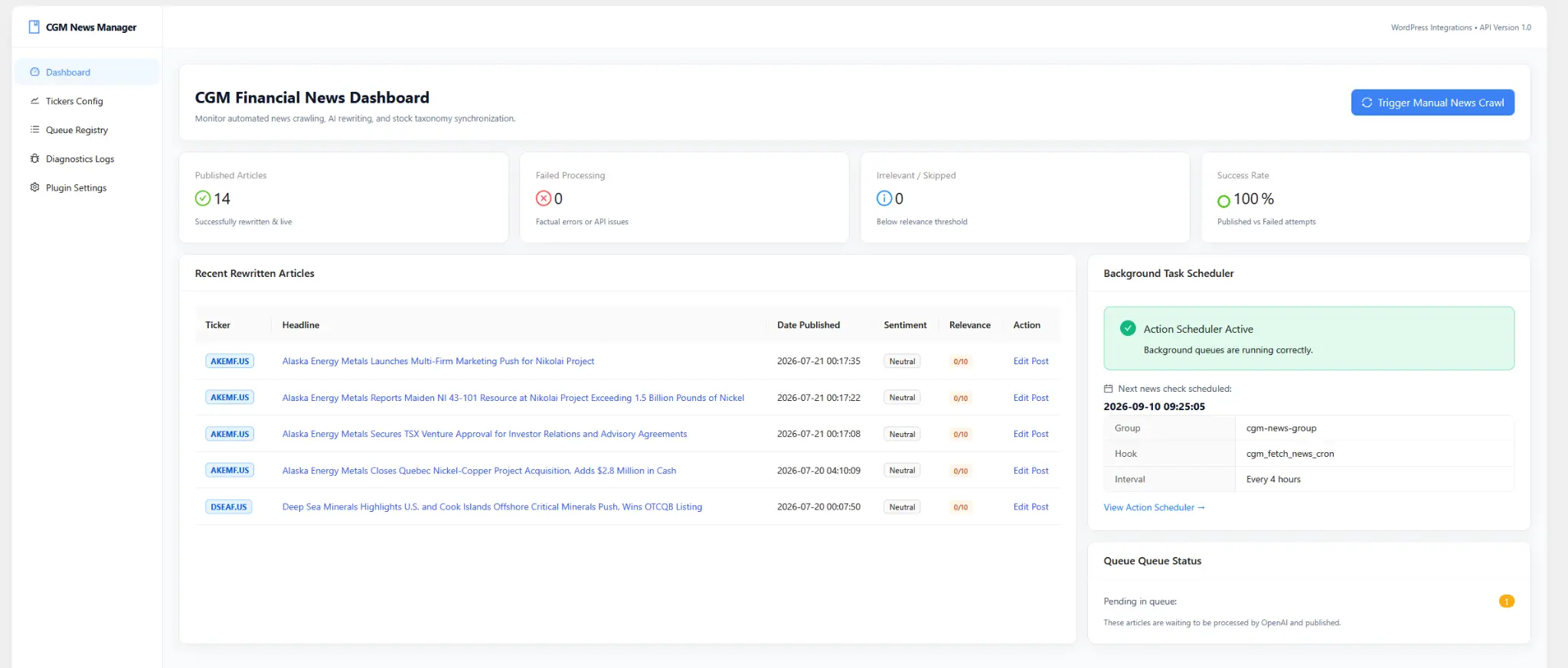
CGM needed to remove the recurring manual effort involved in producing financial-news articles. SleekAlgo built a custom WordPress publishing engine that works by configured ticker/company, collects relevant financial-news information, transforms it into website-specific content with OpenAI, creates SEO metadata, checks for repeated coverage, and publishes through WordPress in English and German.
100%
of the manual workflow replaced
4
tickers currently configured
EN + DE
publishing workflows
SEO + dedupe + attribution
POINT-IN-TIME DASHBOARD SNAPSHOT
14 published · 0 failed · displayed 100% success — a captured state, not a permanent success guarantee, throughput limit or fixed service specification.
Source Monitoring Should Be Part of the System — Not an Editor’s Daily Checklist
A useful architecture separates source collection from content creation so publishers can control which inputs are trusted, how they are mapped to topics and what happens when a source fails or returns nothing new.
Approved Sources
→
Source Registry / Queue
→
Relevance Rules
→
Content Workflow
The Editorial Rules Are as Important as the AI Model
A production publishing system needs explicit rules for what the content should and should not do. The model is only one component inside that controlled workflow.
Required Sections
Terminology
Attribution
Prohibited Claims
Minimum Source Requirements
Metadata
Source Attribution
No automated publishing system can guarantee factual accuracy. Human oversight should match the subject matter and business risk.
SEO-Aware Publishing Without Pretending AI Guarantees Rankings
Automation can support an SEO operation, but publishing more pages does not automatically create search visibility. Quality, usefulness, originality, search intent, site authority, technical SEO and competition still matter.
Meta Titles / Descriptions
Structured Headings
Taxonomy
Contextual Internal Linking
Duplicate Checks
Content Refresh
One Content Engine, Multiple Language Workflows
CGM provides direct proof: the same automation architecture supports English and German financial-news publishing, with the German workflow adding automated translation as a controlled processing stage.
English Workflow
←
Shared Publishing Engine
→
German Workflow
ENGLISH WORKFLOW

GERMAN WORKFLOW
Queues, Status and Diagnostics Keep Automation From Becoming a Black Box
A serious publishing system needs operational visibility. Editors and administrators should be able to understand what the system found, what it processed, what was published and where something failed — this operational layer is one of the major differences between a production content engine and a simple AI-writing tool.
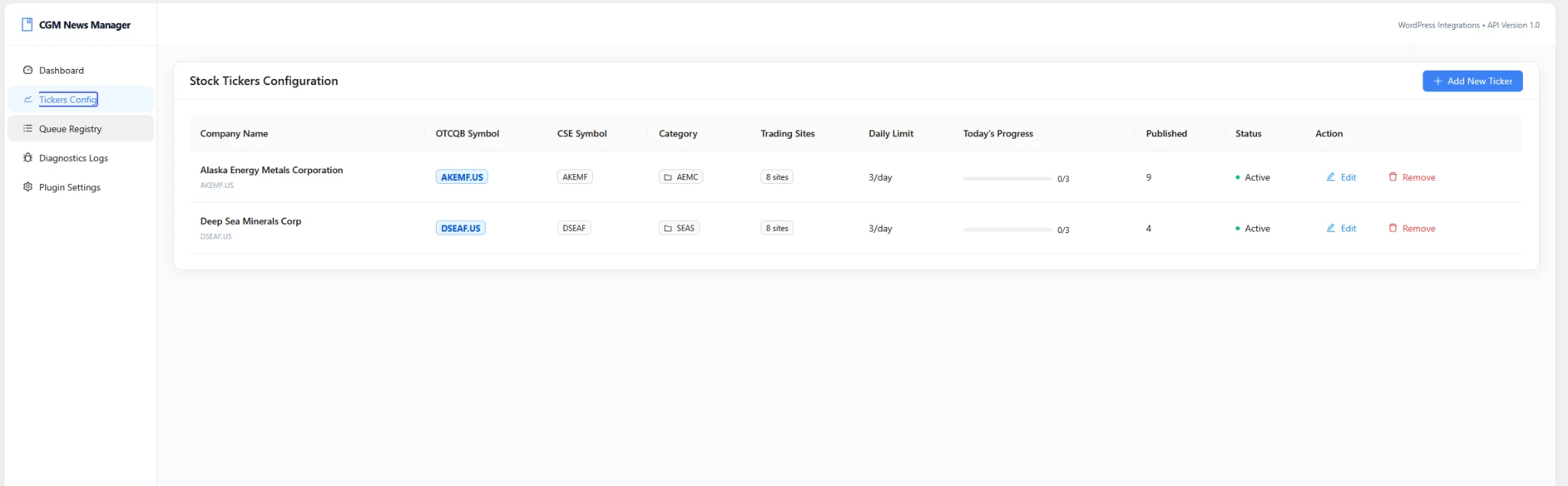
TICKER CONFIGURATION
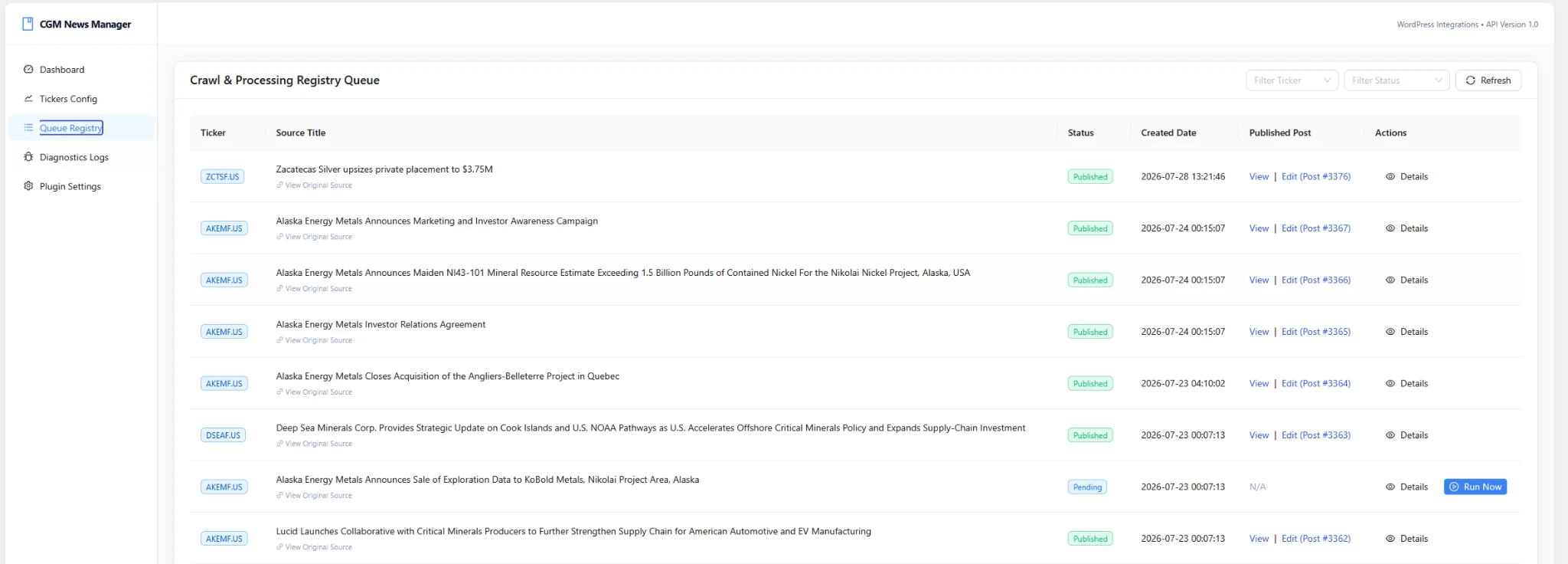
PROCESSING QUEUE
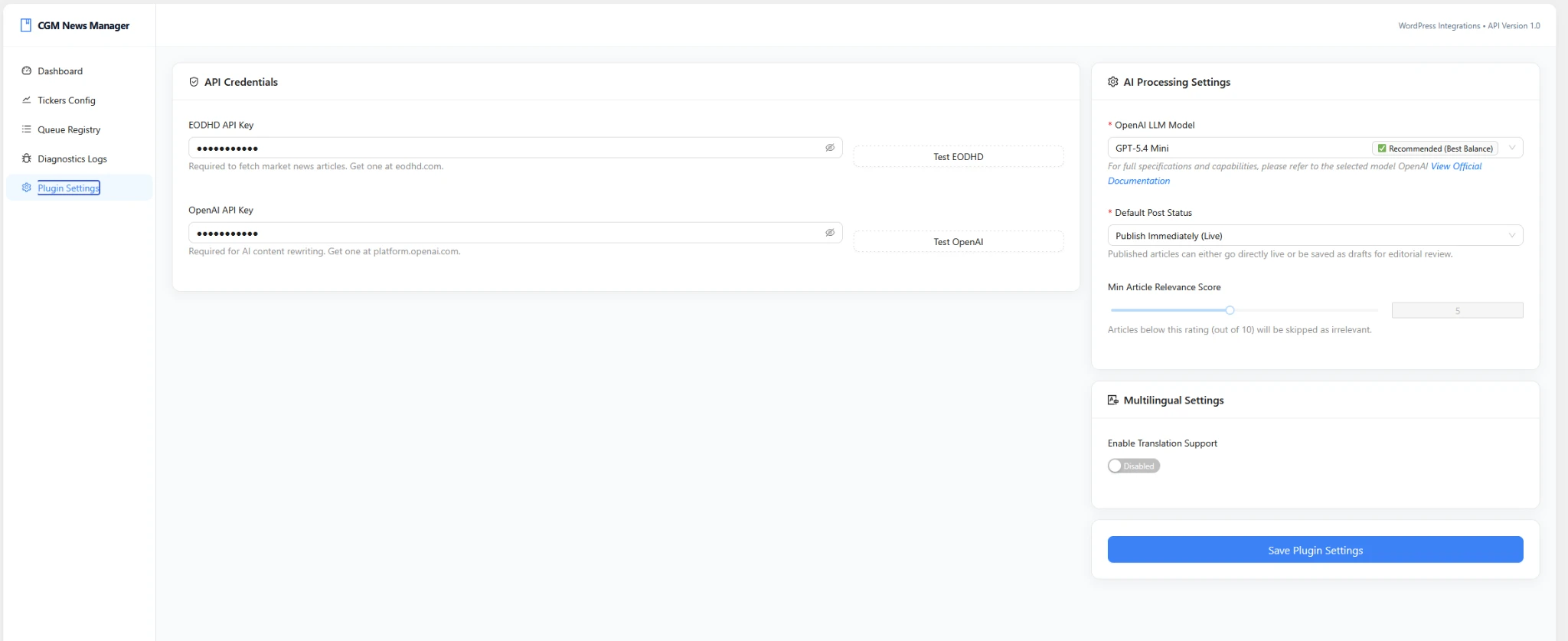
SETTINGS / DIAGNOSTICS
Human Review, Semi-Autonomous or Controlled Autopilot
Not every publishing workflow should use the same level of automation. The right model depends on source quality, subject matter, legal/editorial risk and how much confidence can be built into validation rules.
DRAFT-FIRST
Human Review
Generate and save content for an editor to review.
CONDITIONAL
Semi-Autonomous
Automate predictable steps but require approval before publication.
RULE-BOUND
Controlled Autopilot
Automatically publish content that passes clearly defined rules.
Turn Useful Data Into WordPress Content
The same engineering pattern can support other publishing businesses where structured information needs to become useful website content. These are examples of the architecture’s possible applications, not claims that SleekAlgo has already built every publishing vertical listed — CGM remains the direct proof.
Editorial News
Research Summaries
Industry Updates
Market / Data Commentary
Product / Catalogue Content
Evergreen Educational Content
Data-to-Content Workflows
Custom AI Publishing Does Not Mean Rebuilding WordPress
WordPress already provides a mature publishing foundation: posts, pages, taxonomies, users, media, revisions and an established editorial interface. The custom layer should automate the workflow around publishing rather than replace WordPress unnecessarily.
WordPress Publishing Foundation
→
Custom Automation Layer
Sources · AI · Editorial Rules · Queues · Publishing Controls
Our Process
01
Define the publishing workflow
Content types, audience, sources, recurring work, desired autonomy.
02
Map sources and data
Feeds, APIs, databases or approved inputs that trigger content.
03
Define editorial and validation rules
Structure, metadata, attribution, prohibited outputs, review conditions.
04
Build the WordPress automation
Plugin/integration layer, queues, schedules, model/API connections.
05
Test representative content
Run real scenarios, refine output, edge cases and failure handling.
06
Launch and improve
Move into production; tune sources, rules and processing over time.
Not Every Publisher Should Automate Everything
Automation is valuable where the work is repetitive, rules can be defined and source quality is controllable. High-risk reporting, sensitive claims, investigative work or content that depends heavily on human judgment may need stronger editorial review or may not be appropriate for automatic publication at all.
The goal is not maximum automation. It is the safest useful level of automation for the publishing workflow.
AI Publishing Platform FAQ
An AI writing plugin usually helps a user generate content from prompts. A custom publishing platform connects sources, data, editorial rules, validation, queues, metadata and WordPress publishing into one business-specific workflow.
Yes, where suitable sources or APIs are available and permitted. The workflow can monitor approved feeds, APIs or structured data and send relevant items into processing according to defined rules.
Yes, where the content type and controls justify it. The same architecture can also save everything as drafts or require editorial approval before publication.
Yes. Metadata generation can be included in the workflow, along with taxonomy, article structure and other publishing fields. This does not guarantee search rankings.
Yes. Translation can be integrated as a controlled workflow stage. CGM, for example, uses the same publishing architecture for English and German financial-news output.
The system can use source/content checks and AI-assisted repetition logic to reduce materially repeated coverage. No automated method should be presented as a perfect guarantee against every possible form of duplication.
Yes, where access and data quality allow. A custom workflow can be designed around external APIs, WordPress data, business databases, feeds or other approved sources.
No. Automation can improve publishing efficiency and support SEO processes, but search performance still depends on usefulness, originality, search intent, authority, competition and technical SEO.
Not necessarily. The custom automation can be designed to feed into existing WordPress posts, categories, users, approvals and editorial processes rather than replacing them.
Turn Repetitive Publishing Work Into a Controlled Content Engine
If your team repeatedly monitors the same sources, processes the same types of information and publishes through the same WordPress workflow, we can design an automation system around the work that is actually repeatable — while keeping the editorial controls your business needs.