
Not AI Writing. AI Publishing Infrastructure.
Generating content with an AI model is easy. The problem with one-size-fits-all content engines is that many businesses in the same niche can end up using similar prompts, structures and publishing logic. A serious content operation should reflect what is unique about your business: what you cover, which sources you trust, what data you own, how you communicate and how content moves through WordPress.
GENERIC / SHARED AI CONTENT ENGINE
SITE A
SITE B
SITE C
Same broad workflow
↓
Similar prompts and templates
↓
Similar content structures across many websites
↓
Manual adaptation
One engine, many websites. The differences get added back by hand.
YOUR CUSTOM SLEEKALGO CONTENT ENGINE
YOUR WEBSITE
Your sources and data
The feeds, APIs and records you actually trust
Your opportunity rules
What is worth covering, and what is not
Your research and context
Gathered before anything is written
Your voice and structure
Terminology, tone and article architecture
Your validation
The checks your editorial standards require
Your WordPress publishing workflow
At the autonomy level you chose
One engine, one website. The differences are the architecture.
The value is not access to an AI model. The value is having a content engine engineered specifically for your business rather than sharing the same content-generation logic with every other website in your niche.
Your Business Is Unique. Your Content Engine Should Be Too.
Off-the-shelf AI content systems are designed to work for everyone. We design yours around the things competitors cannot copy from a shared template: your trusted sources, proprietary data, audience, editorial standards, terminology, content architecture and WordPress workflow.
ONE-SIZE-FITS-ALL AI CONTENT
Same broad workflow
Similar prompts and templates
Similar content structures
Built to serve many websites in the same niche
ONE ENGINE · MANY BUSINESSES
YOUR OWN CONTENT ENGINE
Your sources
Your data
Your audience
Your editorial rules
Your terminology
Your taxonomy
Your WordPress publishing logic
ONE ENGINE · ONE BUSINESS
We are not giving you access to our generic AI content engine. We build your content engine, around your business.
01
Topics & Coverage Rules
Define what the system should cover, ignore, prioritize or route for review.
02
Approved Sources
Use selected news feeds, APIs, databases, websites, product data, internal documents or other permitted inputs appropriate to the project.
03
Brand & Editorial Rules
Control tone, audience, structure, terminology, formatting, calls to action and other publishing conventions.
04
WordPress Structure
Populate the correct post types, categories, tags, custom fields, taxonomies and templates.
05
Publishing Logic
Choose whether content becomes a draft, enters an approval queue, is scheduled or can publish automatically under predefined rules.
06
Content Memory
Track what has already been covered to reduce unnecessary duplication and support more coherent future publishing.
THE PIPELINE
From Source to Published WordPress Article
Eight stages, each configurable. What happens at every stage — and how much of it runs without a person — is set during the build.
01
Discover
Monitor or ingest the approved sources, topics, feeds, APIs or data relevant to the website.
02
Select
Apply rules to decide which developments or content opportunities are worth processing.
03
Research
Collect permitted context and source information required to produce a useful piece.
04
Generate
Create original website-specific content using the site’s editorial and structural requirements.
05
Enrich
Add appropriate headings, excerpts, metadata, categories, tags, internal links, structured fields and media instructions where supported.
06
Validate
Run configured checks for structure, duplication, required information, source handling and other project-specific rules.
07
Review or Publish
Send to an editor, schedule it, or publish automatically where the configured workflow permits.
08
Monitor
Record what was produced and, where included, feed content and performance information into future opportunity selection.
SYSTEM FLOW
DISCOVER
→
SELECT
→
RESEARCH
→
GENERATE
→
ENRICH
→
VALIDATE
→
REVIEW / PUBLISH
→
MONITOR
Choose How Autonomous the System Should Be
Autopilot does not mean uncontrolled. Three operating modes cover different levels of editorial risk, and one system can use different modes for different content.
AUTONOMY · CONTROLLED
Human Approved
The system researches and creates the content, but every item remains a WordPress draft until an editor approves it.
AUTONOMY · CONTROLLED
AUTONOMY · CONDITIONAL
Semi-Autonomous
Routine content can move through automated checks while selected topics, sources or risk conditions require human approval.
EXCEPTIONS REVIEWED
AUTONOMY · CONDITIONAL
Controlled Autopilot
Content that satisfies predefined rules can be scheduled or published automatically, with exceptions routed for review.
EXCEPTIONS REVIEWED
The appropriate level of autonomy depends on the niche, source quality, legal and editorial requirements and the consequences of publishing incorrect information. High-stakes topics should use stronger human review.
Content Systems for Different Website Models
The same architecture supports very different publishing operations. What changes is the sources, the rules and the shape of the output.
News & Industry Websites
Monitor relevant developments and turn selected stories into original, website-specific coverage or analysis according to editorial rules.
B2B & Professional Websites
Transform industry developments, company knowledge and approved sources into useful articles for a specific audience.
Ecommerce & WooCommerce
Use catalog and niche data to support product guides, educational content, FAQs, category content and other scalable publishing workflows on WooCommerce stores.
Data-Driven Publishers
Turn structured feeds, APIs, databases or regularly changing datasets into WordPress content where the data supports a useful editorial product.
Multi-Location Businesses
Generate locally relevant drafts or content opportunities using location-specific data and controlled templates without producing thin duplicate pages.
Knowledge-Rich Businesses
Use approved internal documents, knowledge bases and subject-matter material to support content grounded in the organization’s own information.
CASE STUDY
CGM
SYSTEM BUILT BY SLEEKALGO
Automated Financial News Publishing
We built a custom WordPress content automation system that monitors selected financial-news sources, identifies relevant developments, transforms the research into website-specific original content according to defined editorial rules, and moves it through an automated WordPress publishing workflow.
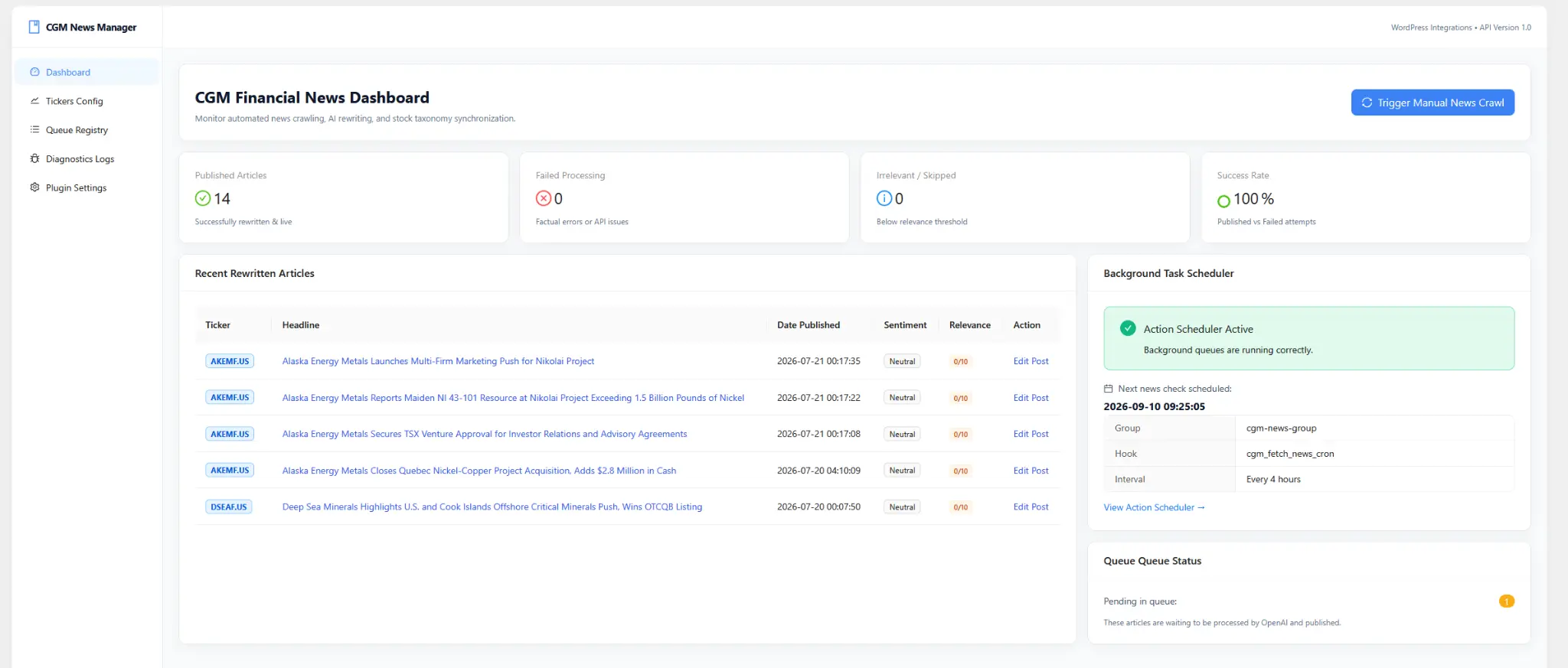
DESKTOP · 1440 VIEWPORT
THE AUTOMATED WORKFLOW
01
Financial sources
↓
02
Relevance detection
↓
03
Research and context
↓
04
Original synthesis
↓
05
Validation
↓
06
WordPress publishing
The system performs source monitoring, research and original synthesis — it does not copy or republish another publisher’s work. Source access and use must respect applicable licensing, permissions and terms.
More Than Articles
A content engine can produce several kinds of output, and knowing when to update rather than publish again is part of the design.
News & Editorial Articles
Timely niche-specific articles driven by monitored sources or data.
Evergreen Content
Structured educational articles and guides based on defined topic plans and approved research inputs.
Product & Category Content
Content derived from product and catalog data, merchandising requirements and search or customer questions.
FAQs & Supporting Content
Generate structured supporting material around products, services, categories or existing articles.
Data-to-Content
Turn structured data into readable WordPress pages or posts where automation creates genuine user value.
Content Updates
Where technically and editorially appropriate, identify existing content that may require refresh rather than always creating another new URL.
SEO-Aware, Without Pretending AI Guarantees Rankings
AI content automation can support an SEO operation, but publishing more pages does not automatically create search visibility. Quality, usefulness, originality, search intent, site authority, technical SEO and competition still matter.
01
Search Intent & Topic Rules
Where included, align content opportunities with the site’s audience and search strategy.
02
On-Page Structure
Generate headings, excerpts, metadata suggestions and structured fields according to defined rules.
03
Internal Linking
Identify relevant existing pages and add or suggest contextual internal links where confidence is sufficient.
04
Taxonomy & Publishing Structure
Assign categories, tags and post types according to the site’s architecture.
05
Avoid Content Flooding
Assign categories, tags and post types according to the site’s architecture.
06
Performance Feedback
Advanced systems can incorporate content and search performance signals into future opportunity review where data access and scope permit.
Your Data and Sources Become Part of the System
The strongest content automation often comes from combining AI with information that generic plugins do not understand about the business.
INPUT
News / RSS / Feeds
Monitor selected external feeds where permitted and appropriate.
INPUT
APIs
Ingest structured information from industry, product, market or business APIs.
INPUT
WordPress Content
Use existing site structure and content context to support continuity and internal linking.
INPUT
WooCommerce Data
Use product, category and catalog information for ecommerce-specific content workflows.
INPUT
Documents & Knowledge
Use approved internal documents or knowledge sources when the implementation requires business-specific grounding.
INPUT · CUSTOM
Custom Databases / Systems
Integrate other business data sources through custom engineering where access and requirements allow.
THE ENGINEERING LAYER
Custom WordPress Engineering Is the Difference
The AI model is only one component. A production content system needs WordPress integration, data handling, scheduling, queues, error handling, source logic, publishing controls and often custom administration interfaces.
Custom WordPress Plugin
Package the workflow into maintainable WordPress functionality where appropriate.
AI / Model APIs
Connect suitable model providers based on the use case rather than tying the solution to one vendor.
Source Integrations
Connect feeds, APIs, data stores and approved external systems.
Background Processing
Schedule monitoring and content jobs without requiring an editor to trigger every run manually.
Editorial Controls
Provide settings, queues, status information and approval controls appropriate to the workflow.
Logging & Recovery
Track important processing states and failures so automated publishing does not become a black box.
Responsible Automation Needs Guardrails
Six controls determine what the system is allowed to do, and what has to stop and wait for a person.
01
Source Rules
Define which sources and data the system is permitted to use and how they should inform generated content.
02
Editorial Rules
Define prohibited claims, required sections, terminology, formatting and escalation conditions.
03
Duplication Controls
Reduce repeated coverage and avoid producing near-identical content at scale.
04
Human Review Where Needed
Route uncertain, sensitive or high-impact content for manual review rather than publishing blindly.
05
Failure Handling
Prevent incomplete or failed generations from automatically becoming public content.
06
Auditability
Keep useful records of what the system processed and produced where the architecture requires it.
No automated content system can guarantee factual accuracy. The workflow and level of human oversight should match the subject matter and business risk.
STARTING IMPLEMENTATION
Custom AI Content Automation from $1,000
A straightforward WordPress autopilot content solution starts at $1,000. The entry implementation is intended for a clearly defined content workflow with limited sources, rules and publishing logic.
$1,000
starting implementation
THE ENTRY IMPLEMENTATION COVERS
ONE CLEARLY DEFINED CONTENT WORKFLOW
Custom content-generation workflow for the agreed use case
WordPress publishing integration
Website-specific editorial and formatting rules
Configured draft, approval or automatic publishing behavior
Basic testing and handoff for the agreed workflow
SCOPED SEPARATELY · MULTI-SOURCE MONITORING
SCOPED SEPARATELY · CUSTOM DASHBOARDS
SCOPED SEPARATELY · FEEDBACK LOOPS
Systems involving continuous multi-source monitoring, advanced opportunity detection, complex research, multiple APIs, extensive validation, custom dashboards, large-scale enrichment or sophisticated feedback loops are scoped separately.
Why SleekAlgo for AI Content Generation?
THE CENTRAL DIFFERENCE
Built for Your Website
The workflow is engineered around the site’s niche, structure, data and publishing requirements.
WordPress Engineering Behind the AI
We can build the plugin, integrations, queues, admin controls and publishing logic required to make the system operational.
Not Locked to a Generic Plugin
The solution is not limited to the settings and features an off-the-shelf AI writer happens to provide.
SEO + Content Context
Our WordPress SEO capability helps us design automation that supports a wider content and search strategy rather than simply maximizing article volume.
Controlled Automation
Choose human approval, semi-autonomous processing or controlled autopilot based on the use case.
Expandable Architecture
Start with one useful workflow and extend sources, rules, content types and automation as the business proves the model. Ongoing maintenance and support keeps it running as models and requirements change.
Our AI Content System Process
01
Define
Choose the content use case, audience, sources, publishing goals and level of autonomy.
02
Design Workflow
Map discovery, research, generation, validation, enrichment and publishing rules.
03
Build
Develop the WordPress integration, AI and API connections and required automation.
04
Train the Rules
Configure prompts and instructions, editorial requirements, taxonomies, source logic and publishing controls.
05
Test & Review
Run representative content through the system, inspect output and refine the workflow.
06
Launch & Improve
Move the approved workflow into production and extend or tune it as real usage reveals opportunities.
AI Content Generation for WordPress FAQ
A generic AI writing plugin usually helps a user generate content from prompts. We build a custom workflow around your niche, sources or data, editorial rules and WordPress publishing process so the system can perform much more of the content operation automatically.
Yes, where appropriate. It can also save everything as drafts or use a semi-autonomous workflow. The right publishing model depends on the subject matter, source quality and level of editorial risk.
Yes. A custom system can monitor approved sources or feeds, identify relevant developments and create original website-specific content based on configured rules. The exact source access and usage must respect applicable permissions, licensing and editorial requirements.
Yes. Depending on the project, the workflow can use WordPress content, WooCommerce data, APIs, documents, databases or other approved business sources.
It can support SEO-oriented workflows such as topic rules, structured articles, metadata, internal links and taxonomy. However, AI-generated content does not guarantee rankings, and publishing large quantities of low-value content is not an SEO strategy.
Yes, where the site structure and confidence rules support it. Some implementations may insert links automatically while others may suggest them for review.
Image generation or media selection can be integrated where appropriate, subject to the chosen providers, licensing, quality requirements and project scope.
The model and provider depend on the use case. We design the workflow around the required quality, capabilities, cost and integration needs rather than making the service dependent on a single AI vendor.
No. AI systems can make mistakes. We can build source grounding, validation rules and human approval into the workflow, but the appropriate safeguards depend on the subject matter and risk.
Straightforward WordPress content automation solutions start at $1,000. More advanced systems with multiple sources, continuous monitoring, complex research, validation, integrations or custom administration are scoped separately.
Yes. The workflow can be maintained, adjusted and extended as sources, models, WordPress requirements and the site’s content strategy evolve.
START THE BUILD
Put Your WordPress Content Operation on Autopilot
Stop treating AI content as a prompt box. Build a website-specific system that finds opportunities, creates content according to your rules and moves it through WordPress with the level of human control your business needs.
CUSTOM AI CONTENT AUTOMATION FROM $1,000
YOUR NICHE · YOUR SOURCES · YOUR RULES · YOUR WORDPRESS WORKFLOW